CloudStack Graduates to Top-Level Apache Project

The Apache Software Foundation announced in late March that CloudStack is now a top-level project. This is a promotion from CloudStack’s incubator status, where it had lived after being released as open source by Citrix.

This promotion provides additional encouragement to companies and developers looking to contribute to the project, because it validates the CloudStack community and demonstrates ongoing support under the Apache Software Foundation. To read more visit the full article.

GD Star Rating
loading...

OpenStack Video Cage Match With Colin McNamara

This post is a little late, mainly because I’m both lazy and distracted.  That being said I hope you’ll enjoy this video of Colin McNamara (@colinmcnamara) and I debating the merits of OpenStack.  For more Engineer’s unplugged goodness from Amy Lewis (@commsninja) visit: http://blogs.cisco.com/datacenter/.

GD Star Rating
loading...

WWT GeekDay 2013

I had the privilege this week to attend the opening keynote and SDN panel of WWT’s Geek Day.  The SDN panel was made up of heavy hitters from Cisco, VMware, HP, and Embrane.  They each presented their vision and solutions for SDN, then teamed up for questions.  The session was very good and was recorded.  I highly recommend watching them at the links below.  For more info on attending or sponsoring this great event see www.geekday.com

Cisco’s Balaji Sivasubramanian:


VMware’s Brad Hedlund:

HP’s Mauicio Sanchez:

Embrane’s Tom Nosella:

GD Star Rating
loading...

Taking a Good Hard Look at SDN

SDN is sitting at the peak of it’s hype cycle (at least I hope it’s the peak.)  Every vendor has a definition and a plan.  Most of those definitions and plans focus around protecting their existing offerings and morphing those into some type of SDN vision.  Products and entire companies have changed their branding from whatever they were to SDN and the markets flooded with SDN solutions that solve very different problems.  This post will take a deep dive into the concepts around SDN and the considerations of a complete solution.  As always with my posts this is focused on the data center network, because I can barely spell WAN, have never spent time on a campus and have no idea what magic it is that service providers do.

The first question anyone considering SDN solutions needs to ask is: What problem(s) am I trying to solve.  Start with the business drivers for the decision.  There are many that SDN solutions look to solve, a few examples are:

  • Faster response to business demands for new tenants, services and applications.
  • More intelligent configuration of network services such as load balancers, firewalls etc.  The ability to dynamically map application tiers to required services.
  • Reductions in cost i.e. CapEx via enabling purchase of lower cost infrastructure and OpEx via reducing administrative overhead of device centric configuration.
  • Ability to create new revenue streams via more intelligent network service offerings.
  • Reduction in lock-in from proprietary systems.
  • Better network integration with cloud management systems and orchestration tools.
  • Better network efficiency through closer match of network resources to application demands.

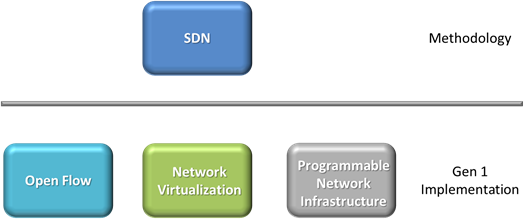
That leaves a lot of areas with room for improvement in order to accomplish those tasks.  That’s one of the reasons the definition is so loose and applied to such disparate technologies.  In order to keep the definition generic enough to encompass a complete solution there are three major characteristics I prefer for defining an SDN architecture:

  • Flow Management – The ability to define flows across the network based on characteristics of the flow in a centralized fashion.
  • Dynamic Scalability – Providing a network that can scale beyond the capabilities of traditional tools and do so in a fluid fashion.
  • Programmability – The ability for the functionality provided by the network to be configured programmatically typically via APIs.

The Complete Picture:

In looking for a complete solution for Software Defined data center network it’s important to assess all aspects required to deliver cohesive network services and packet delivery:

  • Packet delivery – routing/switching as required.  Considerations such as requirements for bridging semantics (flooding, broadcast), bandwidth, multi-pathing etc.
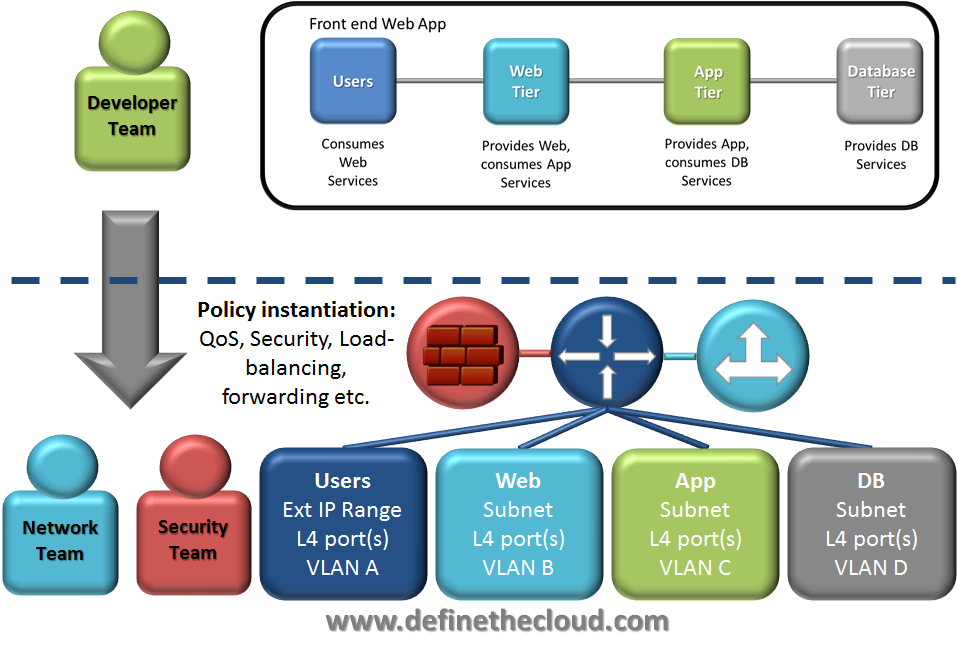
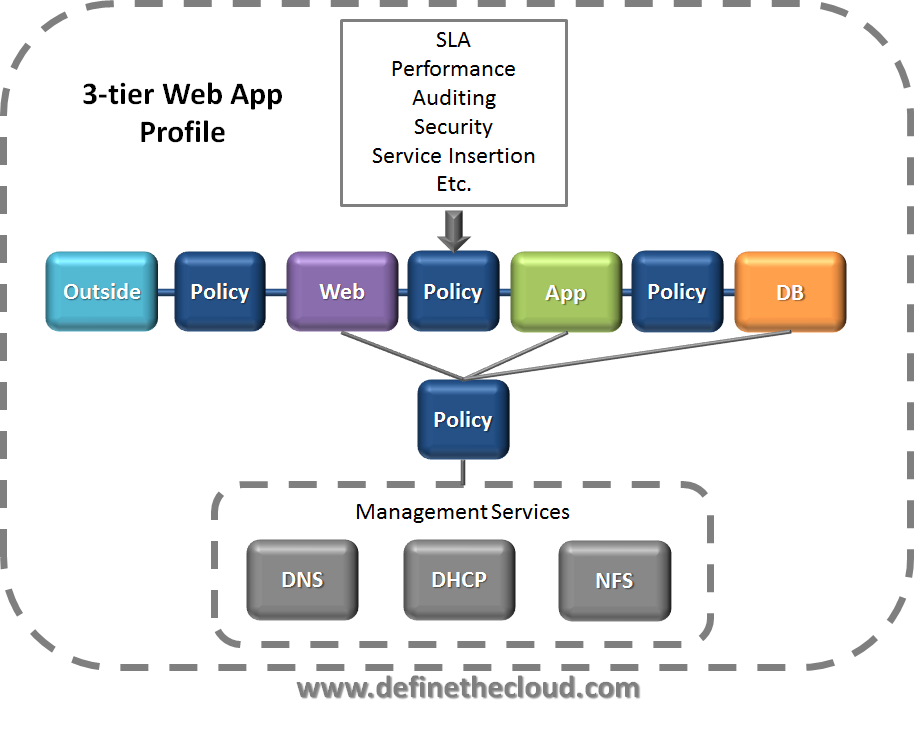
  • L4-L7 service integration – The ability to map application tiers to required network services such as load-balancers and firewalls.
  • Virtual network integration – Virtual switching support for your chosen hypervisor(s).  This will be more complex in multi-hypervisor environments.
  • Physical network integration – Integration with bare-metal servers, standalone appliances, network storage and existing infrastructure.
  • Physical management – The management of the physical network nodes, required configuration of ports, VLANs, routes, etc.
  • Scalability – Ability to scale application or customer tenancy beyond the 4000 VLAN limit.
  • Flow management – The ability to program network policy from a global perspective.

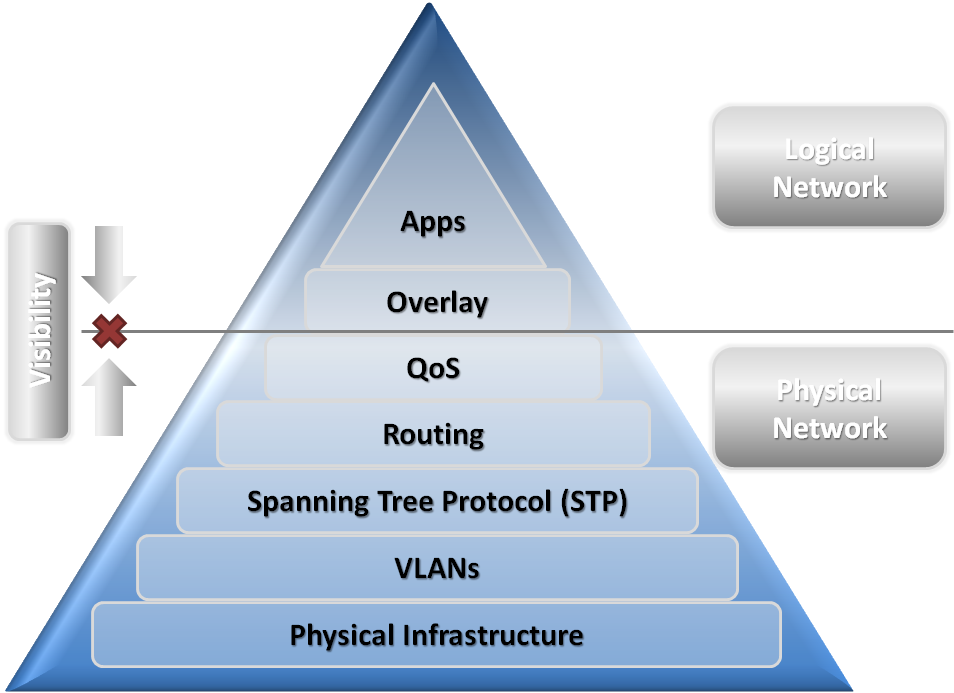
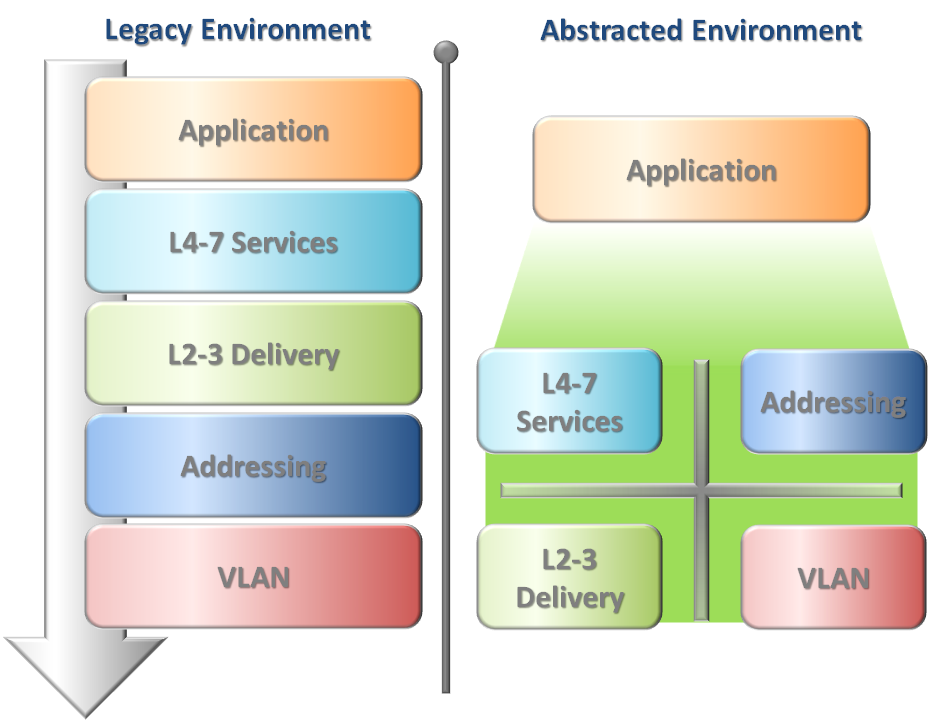
Depending on your overall goals you may not have requirements in each of these areas but you’ll want to analyze that carefully based on growth expectations.  Don’t run your data center like congress kicking the can (problem) down the road.  The graphic below shows the various layers to be considered when looking at SDN solutions.

image

Current Options:

The current options for SDN typically provide solutions for one or more of these issues but not all.  The chart below takes a look at some popular options.


VLAN Scale

L4-7

Bare Metal Support

Physical Network Node MGMT

KVM

VMware

Xen

HyperV

L3

Flow MGMT

Nicira/VMware X 3rd Party *   X * X   3rd Party X
Overlays X       X X X X    
OpenFlow     X   X X X X X X
Midokura X X     X   X   X  

X = Support

* = Future Support
This chart is not intended to be all encompassing or to compare all features of equal products (obviously an overlay doesn’t compete with a Nicira or Midokura solution, and each of those rely on overlays of some type.)  Instead it’s intended to show that the various solutions lumped into SDN provide solutions for different areas of the data center network.  One or more tools may be necessary to deploy a full SDN architecture and even then there may be gaps in areas like bare metal support, integration of standalone network appliances and provisioning/monitoring/troubleshooting of physical switch nodes (yes that all still matters.)
API Model:
Another model lumped into SDN is northbound APIs for network devices.  Several networking vendors are in various stages of support for this model.  This model does provide programmability but I would argue against it’s scale.  Using this model requires top down management systems that understand each device, its capabilities and its API.  To scale this type of management system and program network flows this way is not easy and will be error prone.  Additionally this model does not provide any additional functionality, visibility or holistic programmability, simply a better way to configure individual devices. That being said managing via APIs is light years ahead of screen scrapes and CLI scripting.
Hardware Matters:
Let me preface with what I’m not saying: I’m not saying that hardware will/won’t be commoditized, and I’m not saying that custom silicon or merchant silicon is better or worse.
I am saying that the network hardware you choose will matter.  Table sizes, buffer space, TCAM size will all factor in, and depending on your deployment model will be a major factor.  The hardware will also need to provide maximum available bandwidth and efficient ECMP load-balancing for network throughput.  This load-balancing can be greatly affected by the overlay method chosen based on available header information for hashing algorithms.  Additionally your hardware must support the options of the SDN model you choose.  For example in a Nicira/VMware deployment you’ll have future support for management of switches running OVS, you may want these to tie in physical servers, etc.  The same would apply if you choose OpenFlow.  You’ll need switch hardware that provides OpenFlow support, additionally it will need to support your deployment model hybrid or pure OpenFlow.
The hardware also matters in configuration, management, and troubleshooting.  While there is a lot of talk of “We just need any IP connectivity” that IP network still has to be configured and managed.  Layer 2/3 constructs must be put in place, ports must be configured.  This hardware will also have to be monitored, and troubleshot when things fail.  This will be more difficult in cases where the overlay is unknown to the L3 infrastructure at which point two separate independent networks will be involved: physical and logical.
Management Model:

There are several management models to choose from and two examples in the choices I compared above.  OpenFlow uses a centralized top down approach with the controller pushing flows to all network elements and handling policy for new flows forwarded from those devices.  The Nicira/VMware solution uses the same model as OpenFlow.  Midokura on the other hand takes a play from distributed systems and pushes intelligence to the edges in that fashion.  Each model offers various pros/cons and will play a major role in the scale and resiliency of your SDN deployment.

Northbound API:

The Northbound API is different than the device APIs mentioned below.  This API opens the management of your SDN solution as whole up to higher level systems.  Chances are you’re planning to plug your infrastructure into an automation/orchestration solution or cloud platform.  In order to do this you’ll want a robust northbound API for your infrastructure components, in this case your SDN architecture.  If you have these systems in place, or have already picked your horse you’ll want to ensure compatibility with the SDN architectures you consider.  Not all APIs are created equal, and they are far from standardized so you’ll want to know exactly what you’re getting from a functionality perspective and ensure the claims match your upper layer systems needs.

Additional Considerations:

There are several other considerations which will effect both the options chosen and the architecture used some of those:

  • How are flows distributed?
  • How are unknown flows handled?
  • How are new end points discovered?
  • How are required behaviors of bridging handled?
  • How are bad behaviors of bridging minimized (BUM traffic)?
  • What happens during controller failure scenarios?
  • What is the max theoretical/practical scalability?
    • Does that scale apply globally, i.e. physical and virtual switches etc.?
  • What new security concerns (if any) may be introduced?
  • What are the requirements of the IP network (multicast, etc.)
  • How is multi-tenancy handled?
  • What is the feature disparity between virtualized and physical implementation?
  • How does it integrate with existing systems/services?
  • How is traffic load balanced?
  • How is QoS provided?
  • How are software/firmware upgrades handled?
  • What is the disparity between the software implementation and the hardware capabilities, for example OpenFlow on physical switches?
  • Etc.

Summary:

SDN should be putting the application back in focus and providing tools for more robust and rapid application deployment/change.  In order to effectively do this an SDN architecture should provide functionality for the full life of the packet on the data center network.  The architecture should also provide tools for the scale you forecast as you grow.  Because of the nature of the ecosystem you may find more robust deployment options the more standardized your environment is (I’ve written about standardization several times in the past for example:http://www.networkcomputing.com/private-cloud-tech-center/private-cloud-success-factor-standardiza/231500532 .)  You can see examples of this in the hypervisor support shown in the chart above.

While solutions exist for specific business use cases the market is far from mature.  Products will evolve and as lessons are learned and roadmaps executed we’ll see more robust solutions emerge.  In the interim choose technologies that meet your specific business drivers and deploy them in environments with the largest chance of success, low hanging fruit.  It’s prudent to move into network virtualization in the same fashion you moved into server virtualization, with a staged approach.

GD Star Rating
loading...

Why We Need Network Abstraction

The move to highly virtualized data centers and cloud models is straining the network. While traditional data center networks were not designed to support the dynamic nature of today’s workloads, the fact is, the emergence of highly virtualized environments is merely exposing issues that have always existed within network constructs. VLANs, VRFs, subnets, routing, security, etc. have been stretched well beyond their original intent. The way these constructs are currently used limits scale, application expansion, contraction and mobility.  To read the full article visit: http://www.networkcomputing.com/next-gen-network-tech-center/why-we-need-network-abstraction/240142588

GD Star Rating
loading...

Data Center Overlays 101

I’ve been playing around with Show Me (www.showme.com) as a tool to add some white boarding to the blog.  Here’s my first crack at it covering Data Center Network overlays.

GD Star Rating
loading...

Stateless Transport Tunneling (STT)

STT is another tunneling protocol along the lines of the VXLAN and NVGRE proposals.  As with both of those the intent of STT is to provide a network overlay, or virtual network running on top of a physical network.  STT was proposed by Nicira and is therefore not surprisingly written from a software centric view rather than other proposals written from a network centric view.  The main advantage of the STT proposal is it’s ability to be implemented in a software switch while still benefitting from NIC hardware acceleration.  The other advantage of STT is its use of a 64 bit network ID rather than the 32 bit IDs used by NVGRE and VXLAN.

The hardware offload STT grants relieves the server CPU of a significant workload in high bandwidth systems (10G+.)  This separates it from it’s peers that use an IP encapsulation in the soft switch which negate the NIC’s LSO and LRO functions.   The way STT goes about this is by having the software switch inserts header information into the packet to make it look like a TCP packet, as well as the required network virtualization features.  This allows the guest OS to send frames up to 64k to the hypervisor which are encapsulated and sent to the NIC for segmentation.  While this does allow for the HW offload to be utilized it causes several network issues due to it’s use of valid TCP headers it causes issues for many network appliances or “middle boxes.” 

STT is not expected to be ratified and is considered by some to have been proposed for informational purposes, rather than with the end goal of a ratified standard.  With its misuse of a valid TCP header it would be hard pressed for ratification.  STT does bring up the interesting issue of hardware offload.  The IP tunneling protocols mentioned above create extra overhead on host CPUs due to their inability to benefit from NIC acceleration techniques.  VXLAN and NVGRE are intended to be implemented in hardware to solve this problem.  Both VXLAN and NVGRE use a 32 bit network ID because they are intended to be implemented in hardware, this space provides for 16 million tenants.  Hardware implementation is coming quickly in the case of VXLAN with vendors announcing VXLAN capable switches and NICs. 

GD Star Rating
loading...

VXLAN Deep Dive

I’ve been spending my free time digging into network virtualization and network overlays.  This is part 1 of a 2 part series, part 2 can be found here: http://www.definethecloud.net/vxlan-deep-divepart-2.  By far the most popular virtualization technique in the data center is VXLAN.  This has as much to do with Cisco and VMware backing the technology as the tech itself.  That being said VXLAN is targeted specifically at the data center and is one of many similar solutions such as: NVGRE and STT.)  VXLAN’s goal is allowing dynamic large scale isolated virtual L2 networks to be created for virtualized and multi-tenant environments.  It does this by encapsulating frames in VXLAN packets.  The standard for VXLAN is under the scope of the IETF NVO3 working group.


image

The VXLAN encapsulation method is IP based and provides for a virtual L2 network.  With VXLAN the full Ethernet Frame (with the exception of the Frame Check Sequence: FCS) is carried as the payload of a UDP packet.  VXLAN utilizes a 24-bit VXLAN header, shown in the diagram, to identify virtual networks.  This header provides for up to 16 million virtual L2 networks.

Frame encapsulation is done by an entity known as a VXLAN Tunnel Endpoint (VTEP.)  A VTEP has two logical interfaces: an uplink and a downlink.  The uplink is responsible for receiving VXLAN frames and acts as a tunnel endpoint with an IP address used for routing VXLAN encapsulated frames.  These IP addresses are infrastructure addresses and are separate from the tenant IP addressing for the nodes using the VXLAN fabric.  VTEP functionality can be implemented in software such as a virtual switch or in the form a physical switch.

VXLAN frames are sent to the IP address assigned to the destination VTEP; this IP is placed in the Outer IP DA.  The IP of the VTEP sending the frame resides in the Outer IP SA.  Packets received on the uplink are mapped from the VXLAN ID to a VLAN and the Ethernet frame payload is sent as an 802.1Q Ethernet frame on the downlink.  During this process the inner MAC SA and VXLAN ID is learned in a local table.  Packets received on the downlink are mapped to a VXLAN ID using the VLAN of the frame.  A lookup is then performed within the VTEP L2 table using the VXLAN ID and destination MAC; this lookup provides the IP address of the destination VTEP.  The frame is then encapsulated and sent out the uplink interface.

image

Using the diagram above for reference a frame entering the downlink on VLAN 100 with a destination MAC of 11:11:11:11:11:11 will be encapsulated in a VXLAN packet with an outer destination address of 10.1.1.1.  The outer source address will be the IP of this VTEP (not shown) and the VXLAN ID will be 1001.

In a traditional L2 switch a behavior known as flood and learn is used for unknown destinations (i.e. a MAC not stored in the MAC table.  This means that if there is a miss when looking up the MAC the frame is flooded out all ports except the one on which it was received.  When a response is sent the MAC is then learned and written to the table.  The next frame for the same MAC will not incur a miss because the table will reflect the port it exists on.  VXLAN preserves this behavior over an IP network using IP multicast groups.

Each VXLAN ID has an assigned IP multicast group to use for traffic flooding (the same multicast group can be shared across VXLAN IDs.)  When a frame is received on the downlink bound for an unknown destination it is encapsulated using the IP of the assigned multicast group as the Outer DA; it’s then sent out the uplink.  Any VTEP with nodes on that VXLAN ID will have joined the multicast group and therefore receive the frame.  This maintains the traditional Ethernet flood and learn behavior.

VTEPs are designed to be implemented as a logical device on an L2 switch.  The L2 switch connects to the VTEP via a logical 802.1Q VLAN trunk.  This trunk contains an VXLAN infrastructure VLAN in addition to the production VLANs.  The infrastructure VLAN is used to carry VXLAN encapsulated traffic to the VXLAN fabric.  The only member interfaces of this VLAN will be VTEP’s logical connection to the bridge itself and the uplink to the VXLAN fabric.  This interface is the ‘uplink’ described above, while the logical 802.1Q trunk is the downlink.

image

Summary

VXLAN is a network overlay technology design for data center networks.  It provides massively increased scalability over VLAN IDs alone while allowing for L2 adjacency over L3 networks.  The VXLAN VTEP can be implemented in both virtual and physical switches allowing the virtual network to map to physical resources and network services.  VXLAN currently has both wide support and hardware adoption in switching ASICS and hardware NICs, as well as virtualization software.

GD Star Rating
loading...

Much Ado About Something: Brocade’s Tech Day

Yesterday I had the privilege of attending Brocade’s Tech Day for Analysts and Press.  Brocade announced the new VDX 8770, discussed some VMware announcements, as well as discussed strategy, vision and direction.  I’m going to dig in to a few of the topics that interested me, this is no way a complete recap.

First in regards to the event itself.  My kudos to the staff that put the event together it was excellent from both a pre-event coordination and event staff perspective.  The Brocade corporate campus is beautiful and the EBC building was extremely well suited to such an event.  The sessions went on smoothly, the food was excellent and overall it was a great experience.  I also want to thank Lisa Caywood (@thereallisac) for pointing out that my tweets during the event were more inflammatory then productive and outside the lines of ‘guest etiquette.’  She’s definitely correct and hopefully I can clear up some of my skepticism here in a format left open for debate, and avoid the same mistake in the future.  That being said I had thought I was quite clear going in on who I was and how I write.  To clear up any future confusion from anyone:  if you’re not interested in my unfiltered, typically cynical, honest opinion don’t invite me, I won’t take offense.  Even if you’re a vendor with products I like I’ve probably got a box full of cynicism for your other product lines.

During the opening sessions I observed several things that struck me negatively:

  • A theme (intended or not) that Brocade was being lead into new technologies by their customers.  Don’t get me wrong, listening to your customers and keeping your product in line with their needs is key to success.  That being said if your customers are leading you into new technology you’ve probably missed the boat.  In most cases they’re being lead there by someone else and dragging you along for the ride, that’s not sustainable.  IT vendors shouldn’t need to be dragged kicking and screaming into new technologies by customers.  This doesn’t mean chase every shiny object (squirrel!) but major trends should be investigated and invested in before you’re hearing enough customer buzz to warrant it.  Remember business isn’t just about maintaining current customers it’s about growing by adopting new ones.  Especially for public companies stagnant is as good as dead.
  • The term “ Ethernet Fabric” which is only used by Brocade, everyone else just calls it fabric.  This ties in closely with the next bullet.
  • A continued need to discuss commitment to pure Fibre Channel (FC) storage.  I don’t deny that FC will be around for quite some time and may even see some growth as customers with it embedded will expand.  That being said customers with no FC investment should be avoiding it like the plague and as vendors and consultants we should be pushing more intelligent options to those customers.  You can pick apart technical details about FC vs. anything all day long, enjoy that on your own, the fact is two fold: running two separate networks is expensive and complex, the differences in reliability, performance, etc. are fading if not gone.  Additionally applications are being written in more intelligent ways that don’t require the high availability, low latency silo’d architecture of yester year.  Rather than clinging to FC like a sinking ship vendors should be protecting customer investment while building and positioning the next evolution.  Quote of the day during a conversation in the hall: “Fibre channel is just a slightly slower melting ice cube then we expected.’
  • An insistence that Ethernet fabric was a required building block of SDN.  I’d argue that while it can be a component it is far from required, and as SDN progresses it will be irrelevant completely.  More on this to come.
  • A stance that the network will not be commoditized was common throughout the day.  I’d say that’s either A) naïve or B) posturing to protect core revenue.  I’d say we’ll see network commoditization occur en mass over the next five years.  I’m specifically talking about the data center and a move away from specialized custom built ASICS, not the core routers, and not  the campus.  Custom silicon is expensive and time-consuming to develop, but provides performance/latency benefits and arguable some security benefits.  As the processor and off the shelf chips continue to increase exponentially this differentiator becomes less and less important.  What becomes more important is rapid adaption to new needs.  SDN as a whole won’t rip and replace networking in the next five years but it’s growth and the concepts around it will drive commoditization.  It happened with servers, then storage while people made the same arguments.  Cheaper, faster to produce and ‘good-enough’ consistently wins out.

On the positive side Brocade has some vision that’s quite interesting as well as some areas where they are leading by filling gaps in industry offerings.

  • Brocade is embracing the concept of SDN and understands a concept I tweeted about recently: ‘Revolutions don’t sell.’  Customers want evolutionary steps to new technology.  Few if any customers will rip and replace current infrastructure to dive head first into SDN.  SDN is a complete departure from the way we network today, and will therefore require evolutionary steps to get there. This is shown in their support of ‘hybrid’ open flow implementations on some devices.  This means that OpenFlow implementations can run segregated alongside traditional network deployments.  This allows for test/dev or roll-out of new services without an impact on production traffic.  This is a great approach where other vendors are offering ‘either or’ options.
  • There was discussion of Brocade’s VXLAN gateway which was announced at VMworld.  To my knowledge this is the first offering in this much needed space.  Without a gateway VXLAN is limited to virtual only environments. This includes segregation from services provided by physical devices.  The Brocade VXLAN gateway will allow the virtual and physical networks to be bridged. (http://newsroom.brocade.com/press-releases/brocade-adx-series-to-unveil-vxlan-gateway-and-app-nasdaq-brcd-0923542) To dig deeper on why this is needed check out Ivan’s article: http://blog.ioshints.info/2011/10/vxlan-termination-on-physical-devices.html.
  • The new Brocade VDX 8770 is one bad ass mamma jamma.  With industry leading latency and MAC table capacity, along with TRILL based fabric functionality, it’s built for large scalable high-density fabrics.  I originally tweeted “The #BRCD #VDX8770 is a bigger badder chassis in a world with less need for big bad chassis.” After reading Ivan’s post on it I stand corrected (this happens frequently.)  For some great perspective and a look at specs take a read: http://blog.ioshints.info/2012/09/building-large-l3-fabrics-with-brocade.html.

On the financial side Brocade has been looking good and climbed over $6.00 a share.  There are plenty of conversations stating some of this may be due to upcoming shifts at the CEO level.  They’ve reported two great quarters and are applying some new focus towards federal government and other areas lacking in recent past. I didn’t dig further into this discussion.

During lunch I was introduced to one of the most interesting Brocade offerings I’d never heard of: ‘Brocade Network Subscription”: http://www.brocade.com/company/how-to-buy/capital-solutions/index.page.  Basically you can lease your on-prem network from Brocade Capitol.  This is a great idea for customers looking to shift CapEx to OpEx which can be extremely useful.  I also received a great explanation for the value of a fabric underneath an SDN network from Jason Nolet (VP of Data Center Networking Group.)  Jason’s position (summarized) is that implementing SDN adds a network management layer, rather than removing one.  With that in mind the more complexity we remove from the physical network the better off we are.  What we’ll want for our SDN networks is fast, plug-and-play functionality with max usable links and minimal management.  Brocade VCS fabric fits this nicely.  While I agree with that completely I ‘d also say it’s not the only way to skin that particular cat.  More to come on that.

For the last few years I’ve looked at Brocade as a company lacking innovation and direction.  They clung furiously to FC while the market began shifting to Ethernet, ignored cloud for quite a while, etc.  Meanwhile they burned down deals to purchase them and ended up where they’ve been.  The overall messaging, while nothing new, did have undertones of change as a whole and new direction.  That’s refreshing to hear.  Brocade is embracing virtualization and cloud architectures without tying their cart to a single hypervisor horse.  They are positioning well for SDN and the network market shifts.  Most impressively they are identifying gaps in the spaces they operate and executing on them both from a business and technology perspective.  Examples of this are Brocade Network Subscription and the VXLAN gateway functionality respectively.

Things are looking up and there is definitely something good happening at Brocade.  That being said they aren’t out of the woods yet.  For them, as a company, purchase is far fetched as the vendors that would buy them already have networking plays and would lose half of Brocade’s value by burning OEM relationships with the purchase.  The only real option from a sale perspective is for investors looking to carve them up and sell off pieces individually.  A scenario like this wouldn’t bode well for customers.  Brocade has some work to do but they’ve got a solid set of products and great direction.  We’ll see how it pans out.  Execution is paramount for them at this point.

Final Note:  This blog was intended to stop there but this morning I received an angry accusatory email from Brocade’s head of corporate communications who was unhappy with my tweets.  I thought about posting the email in full, but have decided against it for the sake of professionalism.  Overall his email was an attack based on my tweets.  As stated my tweets were not professional, but this type of email from someone in charge of corporate communications is well over the top in response.  I forwarded the email to several analyst and blogger colleagues, a handful of whom had similar issues with this individual.  One common theme in social media is that lashing out at bad press never does any good, a senior director in this position should know such, but instead continues to slander and attack.  His team and colleagues seem to understand social media use as they’ve engaged in healthy debate with me in regards to my tweets, it’s a shame they are not lead from the front.

GD Star Rating
loading...

Digging Into the Software Defined Data Center

The software defined data center is a relatively new buzzword embraced by the likes of EMC and VMware.  For an introduction to the concept see my article over at Network Computing (http://www.networkcomputing.com/data-center/the-software-defined-data-center-dissect/240006848.)  This post is intended to take it a step deeper as I seem to be stuck at 30,000 feet for the next five hours with no internet access and no other decent ideas.  For the purpose of brevity (read: laziness) I’ll use the acronym SDDC for Software Defined Data Center whether or not this is being used elsewhere.)

First let’s look at what you get out of a SDDC:

Legacy Process:

In a traditional legacy data center the workflow for implementing a new service would look something like this:

  1. Approval of the service and budget
  2. Procurement of hardware
  3. Delivery of hardware
  4. Rack and stack of new hardware
  5. Configuration of hardware
  6. Installation of software
  7. Configuration of software
  8. Testing
  9. Production deployment

This process would very greatly in overall time but 30-90 days is probably a good ballpark (I know, I know, some of you are wishing it happened that fast.)

Not only is this process complex and slow but it has inherent risk.  Your users are accustomed to on-demand IT services in their personal life.  They know where to go to get it and how to work with it.  If you tell a business unit it will take 90 days to deploy an approved service they may source it from outside of IT.  This type of shadow IT poses issues for security, compliance, backup/recovery etc. 

SDDC Process:

As described in the link above an SDDC provides a complete decoupling of the hardware from the services deployed on it.  This provides a more fluid system for IT service change: growing, shrinking, adding and deleting services.  Conceptually the overall infrastructure would maintain an agreed upon level of spare capacity and would be added to as thresholds were crossed.  This would provide an ability to add services and grow existing services on the fly in all but the most extreme cases.  Additionally the management and deployment of new services would be software driven through intuitive interfaces rather than hardware driven and disparate CLI based.

The process would look something like this:

  1. Approval of the service and budget
  2. Installation of software
  3. Configuration of software
  4. Testing
  5. Production deployment

The removal of four steps is not the only benefit.  The remaining five steps are streamlined into automated processes rather than manual configurations.  Change management systems and trackback/chargeback are incorporated into the overall software management system providing a fluid workflow in a centralized location.  These processes will be initiated by authorized IT users through self-service portals.  The speed at which business applications can be deployed is greatly increased providing both flexibility and agility.

Isn’t that cloud?

Yes, no and maybe.  Or as we say in the IT world: ‘It depends.’  SDDN can be cloud, with on-demand self-service, flexible resource pooling, metered service etc. it fits the cloud model.  The difference is really in where and how it’s used.  A public cloud based IaaS model, or any given PaaS/SaaS model does not lend itself to legacy enterprise applications.  For instance you’re not migrating your Microsoft Exchange environment onto Amazon’s cloud.  Those legacy applications and systems still need a home.  Additionally those existing hardware systems still have value.  SDDC offers an evolutionary approach to enterprise IT that can support both legacy applications and new applications written to take advantage of cloud systems.  This provides a migration approach as well as investment protection for traditional IT infrastructure. 

How it works:

The term ‘Cloud operating System’ is thrown around frequently in the same conversation as SDDC.  The idea is compute, network and storage are raw resources that are consumed by the applications and services we run to drive our businesses.  Rather than look at these resources individually, and manage them as such, we plug them into a a management infrastructure that understands them and can utilize them as services require them.  Forget the hardware underneath and imagine a dashboard of your infrastructure something like the following graphic.

image


The hardware resources become raw resources to be consumed by the IT services.  For legacy applications this can be very traditional virtualization or even physical server deployments.  New applications and services may be deployed in a PaaS model on the same infrastructure allowing for greater application scale and redundancy and even less tie to the hardware underneath.

Lifting the kimono:

Taking a peak underneath the top level reveals a series of technologies both new and old.  Additionally there are some requirements that may or may not be met by current technology offerings. We’ll take a look through the compute, storage and network requirements of SDDC one at a time starting with compute and working our way up.

Compute is the layer that requires the least change.  Years ago we moved to the commodity x86 hardware which will be the base of these systems.  The compute platform itself will be differentiated by CPU and memory density, platform flexibility and cost. Differentiators traditionally built into the hardware such as availability and serviceability features will lose value.  Features that will continue to add value will be related to infrastructure reduction and enablement of upper level management and virtualization systems.  Hardware that provides flexibility and programmability will be king here and at other layers as we’ll discuss.

Other considerations at the compute layer will tie closely into storage.  As compute power itself has grown by leaps and bounds  our networks and storage systems have become the bottleneck.  Our systems can process our data faster than we can feed it to them.  This causes issues for power, cooling efficiency and overall optimization.  Dialing down performance for power savings is not the right answer.  Instead we want to fuel our processors with data rather than starve them.  This means having fast local data in the form of SSD, flash and cache.

Storage will require significant change, but changes that are already taking place or foreshadowed in roadmaps and startups.  The traditional storage array will become more and more niche as it has limited capacities of both performance and space.  In its place we’ll see new options including, but not limited to migration back to local disk, and scale-out options.  Much of the migration to centralized storage arrays was fueled by VMware’s vMotion, DRS, FT etc.  These advanced features required multiple servers to have access to the same disk, hence the need for shared storage.  VMware has recently announced a combination of storage vMotion and traditional vMotion that allows live migration without shared storage.  This is available in other hypervisor platforms and makes local storage a much more viable option in more environments.

Scale-out systems on the storage side are nothing new.  Lefthand and Equalogic pioneered much of this market before being bought by HP and Dell respectively.  The market continues to grow with products like Isilon (acquired by EMC) making a big splash in the enterprise as well as plays in the Big Data market.  NetApp’s cluster mode is now in full effect with OnTap 8.1 allowing their systems to scale out.  In the SMB market new players with fantastic offerings like Scale Computing are making headway and bringing innovation to the market.  Scale out provides a more linear growth path as both I/O and capacity increase with each additional node.  This is contrary to traditional systems which are always bottle necked by the storage controller(s). 

We will also see moves to central control, backup and tiering of distributed storage, such as storage blades and server cache.  Having fast data at the server level is a necessity but solves only part of the problem.  That data must also be made fault tolerant as well as available to other systems outside the server or blade enclosure.  EMC’s VFcache is one technology poised to help with this by adding the server as a storage tier for software tiering.  Software such as this place the hottest data directly next the processor with tier options all the way back to SAS, SATA, and even tape.

By now you should be seeing the trend of software based feature and control.  The last stage is within the network which will require the most change.  Network has held strong to proprietary hardware and high margins for years while the rest of the market has moved to commodity.  Companies like Arista look to challenge the status quo by providing software feature sets, or open programmability layered onto fast commodity hardware.  Additionally Software Defined Networking (http://www.definethecloud.net/sdn-centralized-network-command-and-control) has been validated by both VMware’s acquisition of Nicira and Cisco’s spin-off of Insieme which by most accounts will expand upon the CiscoOne concept with a Cisco flavored SDN offering.  In any event the race is on to build networks based on software flows that are centrally managed rather than the port-to-port configuration nightmare of today’s data centers. 

This move is not only for ease of administration, but also required to push our systems to the levels required by cloud and SDDC.  These multi-tenant systems running disparate applications at various service tiers require tighter quality of service controls and bandwidth guarantees, as well as more intelligent routes.  Today’s physically configured networks can’t provide these controls.  Additionally applications will benefit from network visibility allowing them to request specific flow characteristics from the network based on application or user requirements.  Multiple service levels can be configured on the same physical network allowing traffic to take appropriate paths based on type rather than physical topology.  These network changes are require to truly enable SDDC and Cloud architectures. 

Further up the stack from the Layer 2 and Layer 3 transport networks comes a series of other network services that will be layered in via software.  Features such as: load-balancing, access-control and firewall services will be required for the services running on these shared infrastructures.  These network services will need to be deployed with new applications and tiered to the specific requirements of each.  As with the L2/L3 services manual configuration will not suffice and a ‘big picture’ view will be required to ensure that network services match application requirements.  These services can be layered in from both physical and virtual appliances  but will require configurability via the centralized software platform.

Summary:

By combining current technology trends, emerging technologies and layering in future concepts the software defined data center will emerge in evolutionary fashion.  Today’s highly virtualized data centers will layer on technologies such as SDN while incorporating new storage models bringing their data centers to the next level.  Conceptually picture a mainframe pooling underlying resources across a shared application environment.  Now remove the frame.

GD Star Rating
loading...